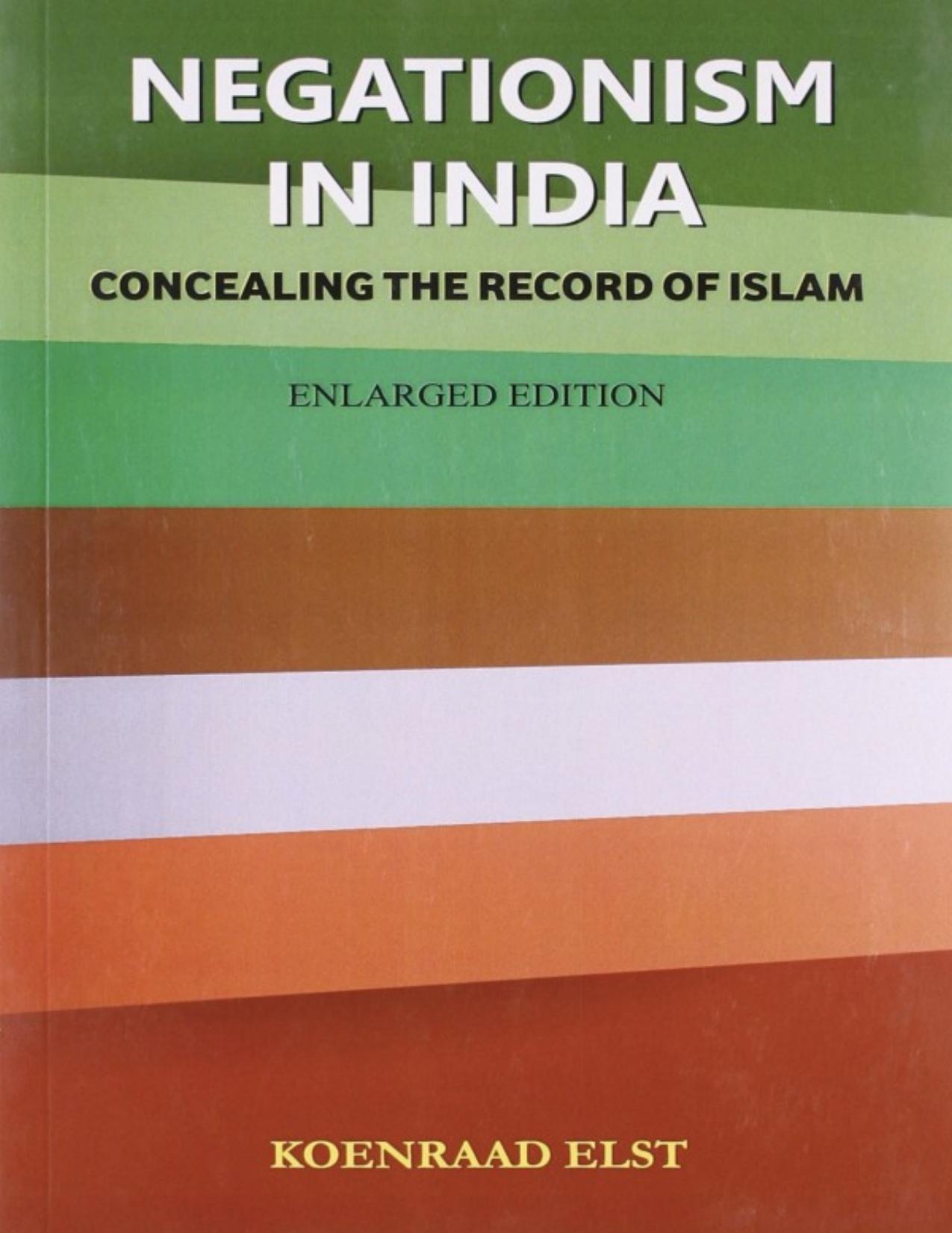
Negationism in India: Concealing the Record of Islam by Koenraad Elst
Author:Koenraad Elst
Language: eng
Format: azw3, epub, pdf
Published: 2014-08-08T18:30:00+00:00
2.2 NEGATIONISM AND THE INDIAN NATIONAL CONGRESS
The political context of the frist attempts at negationism was chiefly the attempt of the independence movement, led by the Indian National Congress, to eliminate all factors of disunity between Hindus and Muslims. It was the time of the Khilafat movement (1919-23), the agitation of Indian Muslims against the British take-over of the Islamic sacred places from the deceased Ottoman empire. The khilafatists demanded the restoration of the Ottoman caliph's authority over the sacred places. Congress saw in this the occasion to enlist the Muslims in the national freedom struggle against the same British imperialists.
This was a miscalculation: the khilafat movement intensified the Islamic sense of communal identity (therefore the rejection of Indian nationalism), and added considerably to Muslim separatism and the Pakistan ideology. But before 1923, when the Turks themselves abolished the caliphate so that the movement lost its raison d'etre (and got transmuted into pogroms against the Hindus), there was great expectation in Congress circles. Therefore, Congress people were willing to go to any length to iron out the differences between Hindus and Muslims, including the invention of centuries of communal amity.
At that time, the Congress leders were not yet actively involved in the rewriting of history. They were satisfied to quietly ignore the true history of Hindu-Muslim relations. After the communal riots of Kanpur in 1931, a Congress report advised the elimination of the mutual enemy- image by changing the contents of the history-books.
The next generation of political leaders, especially the left-wing that was to gain control of Congress in the thirties, and complete control in the fifties, would profess negationism very explicitly. The radical humanist (i.e. bourgeois Marxist) M.N. Roy wrote that Islam had fulfilled a historic mission of equality and abolition of discrimination, and that for this, Islam had been welcomed into India by the lower castes. If at all any violence had occurred, it was as a matter of justified class struggle by the progressive forces against the reactionary forces, meaning the fedual Hindu upper castes.
This is a modern myth springing from an incorrect and much too grim picture of the caste system, a back-projection of modern ideas of class struggle, and an uncritical swallowing of contemporary Islamic apologetics, which has incorporated some voguish socialist values. There is no record anywhere of low-caste people welcoming the Muslims as liberators. Just like in their homeland, the Muslim generals had nothing but contempt for the common people, and all the more so because these were idolaters. They made no distinction between rich Pagans and poor Pagans: in the Quran, Allah had promised the same fate to all idolaters.
By contrast, there is plenty of testimony that these common people rose in revolt, not against their high-caste co-religionists, but against the Muslim rulers. And not only against heavy new taxes (50% of the land revenue for Alauddin Khilji, whom the negationists hail as the precursor of socialism) and land expropriations, but especially against the rape and abduction of women and children and
Download
Negationism in India: Concealing the Record of Islam by Koenraad Elst.epub
Negationism in India: Concealing the Record of Islam by Koenraad Elst.pdf
This site does not store any files on its server. We only index and link to content provided by other sites. Please contact the content providers to delete copyright contents if any and email us, we'll remove relevant links or contents immediately.
Personalized inhaled bacteriophage therapy for treatment of multidrug-resistant Pseudomonas aeruginosa in cystic fibrosis by unknow(176840)
CONSORT 2025 statement: updated guideline for reporting randomized trials by unknow(85287)
Critical evaluation of the ProfiLER-02 study design and outcomes by Vivek Subbiah & Razelle Kurzrock(84900)
Cardiac gene therapy makes a comeback by Oliver J. Müller & Susanne Hille & Anca Kliesow Remes(84673)
Whisky: Malt Whiskies of Scotland (Collins Little Books) by dominic roskrow(74441)
Unveiling the design rules for tunable emission in graphene quantum dots: A high-throughput TDDFT and machine learning perspective by Şener Özönder & Mustafa Coşkun Özdemir & Caner Ünlü(50894)
A yeast-based oral therapeutic delivers immune checkpoint inhibitors to reduce intestinal tumor burden by unknow(40264)
Covalent hitchhikers guide proteins to the nucleus by Alexander F. Russell & Madeline F. Currie & Champak Chatterjee(40216)
Meet the Authors: Christopher R. Mansfield and Emily R. Derbyshire by Christopher R. Mansfield & Emily R. Derbyshire(40096)
Alkaline-earth metals promote propane dehydrogenation with carbon dioxide through geometric effects: Altering the reaction pathway by unknow(32734)
Induced iron vacancies boosting FeOOH loaded on sustainable Fenton-like collagen fiber membrane for efficient removal of emerging contaminants by unknow(32509)
Efficient electric-field-assisted photochemical conversion of methane to n-propanol exclusively over penetrated TiO2Ti hollow fibers by Guanghui Feng(32454)
Bi2SiO5 nanosheets as piezo-photocatalyst for efficient degradation of 2,4-Dichlorophenol by Hangyu Shi & Yifu Li & Lishan Zhang & Guoguan Liu & Qian Zhang & Xuan Ru & Shan Zhong(32389)
A novel NDIPTA organic heterojunction photocatalyst with built-in electric field for efficient hydrogen production by Jiahui Yang & Baojun Ma & Yongfa Zhu(32362)
Enhanced conversion of methane to liquid-phase oxygenates via hollow ferrite nanotube@horseradish peroxidase based photoenzymatic catalysis by Jun Duan & Shiying Fan & Xinyong Li & Shaomin Liu(32333)
Ordered macroporous superstructure of defective carbon adorned with tiny cobalt sulfide for selective electrocatalytic hydrogenation of cinnamaldehyde by Xiao-Shi Yuan & Sheng-Hua Zhou & San-Mei Wang & Wenbo Wei & Xiaofang Li & Xin-Tao Wu & Qi-Long Zhu(32259)
What's Done in Darkness by Kayla Perrin(27150)
Topological analysis of non-conjugated ethylene oxide cored dendrimers decorated with tetraphenylethylene: Insights from degree-based descriptors using the polynomial approach by A Theertha Nair & D Antony Xavier & Annmaria Baby & S Akhila(26527)
Investigation of mechanical and self-healing properties of hydroxyl-terminated polybutadiene functionalized with 2-ureido-4-pyrimidinone by Mohsen Kazazi & Mehran Hayaty & Ali Mousaviazar(26460)
